You type "modern minimalist product photography, natural lighting, white background" and seconds later, you have a studio-quality image. But how does AI actually create images from text?
For brands using AI image generation—or considering it—understanding the underlying technology helps you make better creative decisions, write effective prompts, and know when AI is (and isn't) the right tool.
This guide breaks down how AI image generation works, from diffusion models to training data, with a focus on what matters for brand creative work.
Key Takeaways
- AI generates images through diffusion models that learn to reverse noise into coherent images based on text prompts
- Training data quality determines output quality—models trained on billions of images learn visual patterns, styles, and compositions
- Text prompts are encoded into vectors that guide the AI's generation process, making prompt engineering critical for brand work
- Accuracy improves with iteration—modern models (2024-2026) produce photo-realistic results indistinguishable from traditional photography
- Brands benefit most when they understand how the tech works—better prompts = better creative output at scale
2026 Update: The State of AI Image Generation
AI image generation has evolved dramatically since its mainstream emergence. Here's what's changed by 2026:
Diffusion Transformers (DiTs) Are Now Standard: The shift toward Diffusion Transformers—a hybrid architecture that combines the strength of diffusion-based image synthesis with the attention mechanisms of transformer models—has meaningfully improved both output quality and generation speed. This represents a significant advancement over earlier pure diffusion models.
4K Output is the New Baseline: What required specialized settings in 2023 is now standard. Most modern image generators (Midjourney v6+, DALL-E 3, Flux, Firefly 3) produce 4K resolution outputs by default, suitable for print and large-format digital applications.
Real-Time Knowledge Integration: The best 2026 models pull live web data during generation for accurate product visuals and current-context content instead of relying solely on stale training data. This enables more accurate representation of recent products, trends, and visual styles.
From GANs to Diffusion Dominance: While Generative Adversarial Networks (GANs) powered early AI image generation, diffusion models have largely replaced them for creative applications due to superior quality, controllability, and training stability. Understanding this evolution helps brands choose the right tools.
How Does AI Create Images from Text?
At the highest level, AI image generation transforms text descriptions into visual content through a process called diffusion. Think of it like this:
Traditional photography: Capture light → Process image → Final photo AI image generation: Text input → Pattern recognition → Reverse noise → Final image
Here's what actually happens when you hit "generate":
Step 1: Text Encoding (Understanding Your Prompt)
When you input a text prompt like "product shot of athletic shoes on wet pavement, dramatic sunset lighting", the AI doesn't "read" it like a human. Instead:
- The text is broken into tokens (words or word fragments)
- These tokens are converted into numerical vectors (mathematical representations)
- The AI matches these vectors to learned visual concepts from its training data
- A text encoder (often CLIP or similar) creates a mathematical "understanding" of your prompt
Why this matters for brands: The more specific and detailed your prompts, the better the AI can match your vision. Vague prompts ("cool sneaker photo") produce generic outputs. Detailed prompts ("Nike ACG trail runner on volcanic rock, golden hour, 35mm, shallow depth of field") give the AI clearer instructions.
Step 2: Starting with Noise (The Diffusion Process Begins)
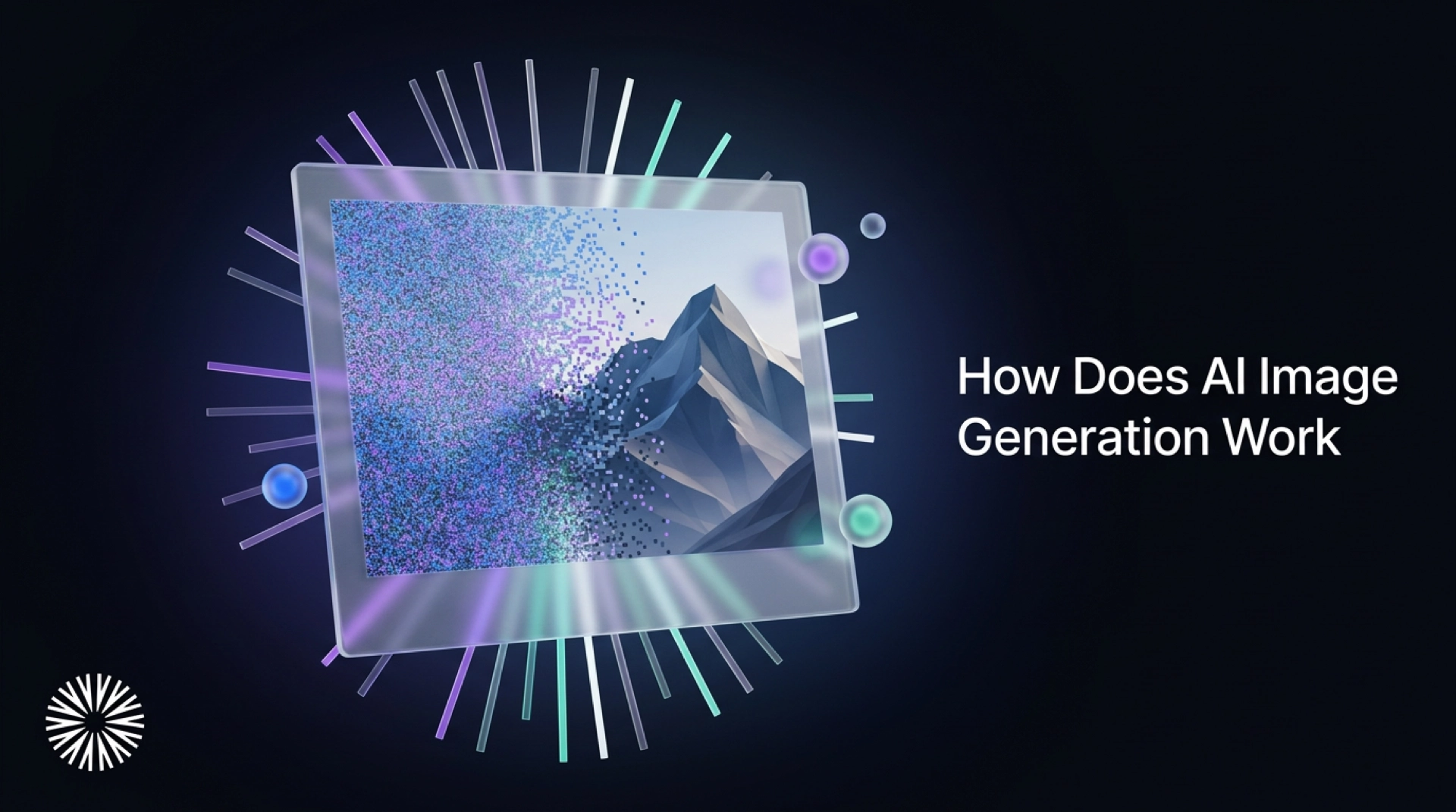
Here's where it gets interesting. The AI doesn't start with a blank canvas—it starts with random noise (static, like TV interference). This might seem backwards, but it's the key to diffusion models.
The model has been trained to:
- Take a normal image
- Gradually add noise until it's completely random
- Learn to reverse this process step by step
During generation, the model reverses what it learned:
- Starts with pure noise
- Gradually removes noise over many steps (typically 20-50 iterations)
- Each step refines the image based on your text prompt
- Final step produces a coherent, detailed image
Visual analogy: Imagine sculpting. Traditional art adds material (clay, paint) to create form. Diffusion is like starting with a block of marble and removing material until the sculpture emerges—except the "marble" is mathematical noise.
Step 3: Guided Denoising (Your Prompt Steers the Process)
As the AI removes noise step by step, your text prompt guides each iteration. The model constantly asks itself: "Does this emerging image match the text description?"
This happens through classifier-free guidance:
- The model predicts what the image should look like with your prompt
- It also predicts what it would look like without your prompt (unconditional)
- The difference between these predictions strengthens the connection to your text
- Higher guidance values = stronger adherence to your prompt (but can reduce creative variation)
Why this matters for brands: Understanding guidance helps you control creative output. Need exact brand colors and composition? Increase guidance. Want more creative exploration? Lower guidance for more variation.
What is a Diffusion Model? (Simplified for Marketers)
Diffusion models are the architecture behind most modern AI image generators (Midjourney, DALL-E 3, Stable Diffusion, Adobe Firefly). They work fundamentally differently than older AI methods (like GANs).
The Training Process
Before an AI can generate images, it must be trained on millions (or billions) of image-text pairs:
- Dataset Collection: Models train on massive datasets—LAION-5B (5 billion images), proprietary datasets, licensed stock libraries
- Learning Corruption: The model learns to add noise to images progressively
- Learning Recovery: It learns to reverse this noise, step by step
- Pattern Recognition: Through billions of examples, it learns visual concepts: "sunset lighting," "minimalist composition," "product photography," "brand aesthetic"
Training determines capabilities: A model trained mostly on art won't excel at product photography. A model trained on diverse commercial imagery (like Adobe Firefly) better understands brand needs.
Latent Space (Where the Magic Happens)
This is the technical part that matters for brand work:
Images exist in latent space—a compressed mathematical representation of visual information. Think of it as:
- Pixel space: The actual image (1024x1024 pixels = over 1 million data points)
- Latent space: A compressed version (maybe 64x64 = 4,096 data points)
The AI works in latent space (much faster), then expands back to pixels at the end. This is why:
- Generation is relatively fast (seconds, not hours)
- You can make variations by tweaking latent representations
- Models can interpolate between concepts ("athletic shoe" + "luxury branding" = hybrid outputs)
Brand application: This is why you can generate variations of the same concept, remix styles, or blend visual themes—the latent space allows mathematical manipulation of visual ideas.
Diffusion Models vs GANs: Understanding the Evolution
What are GANs? Generative Adversarial Networks (GANs) were the dominant AI image generation architecture before diffusion models. A GAN has two competing neural networks:
- Generator: Creates images trying to fool the discriminator
- Discriminator: Judges whether images are real or AI-generated
The generator and discriminator play an adversarial game, constantly improving until the generator creates convincing images.
Why Diffusion Models Won for Creative Work
While GANs powered early breakthroughs (StyleGAN, etc.), diffusion models have largely replaced them for brand creative because:
| Aspect | GANs | Diffusion Models |
|---|---|---|
| Quality | Can produce high quality but inconsistent | Consistently photo-realistic with 4K standard |
| Training | Difficult, unstable ("mode collapse" issues) | Stable, scalable training |
| Control | Limited text-to-image capability | Excellent prompt-based control |
| Diversity | Can get stuck generating similar outputs | Wide variety from single prompt |
| Speed | Faster generation (fewer steps) | Slower but improving with DiTs |
Current landscape (2026): Diffusion models (especially Diffusion Transformers) dominate brand creative workflows. GANs remain useful for specific applications like face generation and real-time video synthesis, but for product photography, marketing visuals, and brand content, diffusion is the standard.
Why this matters for brands: Understanding this evolution explains why modern tools (Midjourney, DALL-E 3, Firefly) produce more reliable, controllable results than earlier AI image generators. The technology matured.
Neural Networks: The Foundation
AI image generation is built on neural networks—computational models inspired by the human brain's structure:
How Neural Networks Work for Image Generation:
- Layers of neurons: Information flows through multiple layers, each processing and transforming data
- First layer: Receives raw input (text or noise)
- Middle layers: Extract increasingly complex features (edges → shapes → objects → compositions)
- Final layer: Produces the output image
Training process: The network sees billions of examples, adjusting its internal parameters (weights) to minimize errors. Over time, it learns to:
- Recognize patterns across millions of images
- Associate text descriptions with visual features
- Generate new images that match learned patterns
For brands: This hierarchical learning structure is why AI can understand both low-level details ("soft lighting") and high-level concepts ("luxury brand aesthetic")—the multi-layer architecture processes information at different levels of abstraction.
How AI Image Generators Learn Visual Patterns
The quality of AI-generated images depends entirely on what the model learned during training. Here's what training data teaches:
Visual Concepts
Through millions of examples, models learn:
- Objects: What a "sneaker," "laptop," "perfume bottle" looks like from countless angles
- Styles: Minimalist, maximalist, retro, futuristic, editorial, commercial
- Compositions: Rule of thirds, symmetry, negative space, depth of field
- Lighting: Golden hour, studio lighting, dramatic shadows, soft diffusion
- Contexts: Products in lifestyle settings, seasonal environments, brand aesthetics
Text-Image Associations
Models learn which words correspond to which visual elements:
- "Cinematic" → wide aspect ratio, film grain, dramatic lighting
- "Product photography" → clean backgrounds, professional lighting, sharp focus
- "Lifestyle shot" → human context, environmental storytelling, natural poses
Critical for brands: The model's training determines its "vocabulary." If it hasn't seen enough examples of your specific product category or brand style, outputs will be generic. This is why fine-tuning or style references matter.
How Accurate is AI Image Generation for Brands?
Accuracy in AI image generation breaks down into several dimensions brands care about:
Photo-Realism (2026 State)
Current capabilities:
- Modern models (Midjourney v6+, DALL-E 3, Flux, Firefly 3) with Diffusion Transformer architecture produce 4K photo-realistic images indistinguishable from traditional photography in most contexts
- Real-time knowledge integration enables accurate representation of current products and trends
- Best for: Product shots, lifestyle scenes, environmental photography, concept visualization, high-resolution marketing assets
- Still challenging (but improving): Complex human expressions requiring emotional nuance, small text rendering on products (better than 2024 but not perfect), extremely precise brand logos with intricate geometry
Accuracy threshold for brands:
- Concept testing/A/B creative: 95%+ accurate—perfect for rapid iteration
- Social media content: 90%+ accurate—good enough for most organic posts
- Hero campaign imagery: 80-90% accurate—often needs human refinement for flagship work
- Legal/compliance-critical: Use with caution—human review essential
Brand Consistency
AI can maintain brand consistency if properly directed:
- ✅ With style references: Upload your brand imagery, AI learns your aesthetic
- ✅ With detailed prompts: Specify colors (hex codes), compositions, lighting
- ✅ With fine-tuning: Train models on your specific brand library (advanced)
- ❌ Without guidance: Generic outputs that don't match your brand
Best practice: Treat AI as a tool requiring creative direction, not a replacement for brand expertise.
Technical Accuracy
Where AI excels vs. struggles:
Strengths:
- Consistent lighting across scenes
- Impossible or expensive shots (products in exotic locations)
- Rapid variations (same product, 50 different backgrounds)
- Seasonal/regional variants (summer vs. winter scenes)
Limitations (improving rapidly):
- Fine text (product labels, packaging copy)
- Complex brand logos with precise geometry
- Exact product dimensions/proportions (can hallucinate details)
- Legal compliance (human review required for regulated industries)
From Technical Understanding to Creative Application
Now that you understand how AI generates images, here's how that knowledge translates to better brand work:
1. Write Better Prompts
Understanding the tech helps you prompt more effectively:
Weak prompt: "Cool product photo" Strong prompt: "Product photography of [your product], minimalist white studio background, soft diffused lighting, shot on Phase One IQ4, 80mm lens, f/2.8, centered composition, commercial advertising style"
The AI understands photography terminology because it learned from millions of captioned professional images.
2. Choose the Right Model for Your Needs
Different models excel at different tasks:
- Midjourney: Artistic, stylized, great for concept work and brand mood boards
- DALL-E 3: Coherent compositions, good text understanding, commercial-friendly
- Adobe Firefly: Trained on licensed content, enterprise-safe, integrates with Adobe tools
- Stable Diffusion: Open-source, customizable, can fine-tune on your brand
Decision framework: Match the model's training to your creative goal.
3. Understand Quality vs. Speed Tradeoffs
Diffusion models trade off speed and quality through:
- Number of steps: More steps = higher quality but slower (20 steps = fast, 50 steps = high quality)
- Resolution: Higher resolution = more detail but exponentially slower
- Guidance strength: Higher = more prompt adherence but less creative variation
For rapid concepting, use fewer steps. For final assets, max out quality settings.
4. Know When to Use AI vs. Traditional Production
AI image generation works best when:
- ✅ You need speed (concepts in minutes vs. days)
- ✅ You need volume (hundreds of variations)
- ✅ Budget is constrained (testing creative hypotheses)
- ✅ Locations/scenarios are difficult/expensive to shoot
- ✅ You're exploring creative directions before committing
Traditional photography/production still wins when:
- ❌ Exact product accuracy is legally required
- ❌ You need celebrity/influencer endorsements
- ❌ Brand guidelines demand specific photography standards
- ❌ Regulated industries require human-shot imagery
The Future: What's Coming in AI Image Generation
The technology is evolving rapidly. Here's what's already here and what's next:
Current State (2026) - Already Reality
Many of yesterday's "future" capabilities are now standard:
- ✅ 4K output as baseline: High-resolution generation is the norm
- ✅ Diffusion Transformers (DiTs): Hybrid architecture delivers better quality and speed
- ✅ Real-time knowledge integration: Models pull live web data during generation
- ✅ Improved consistency: Multi-image generation with same subjects (getting better)
- ✅ Better text rendering: Small product text is improved (not perfect, but usable in many cases)
- ✅ Brand-specific models: Fine-tuning on custom datasets now accessible to enterprises
Near-term (2026-2027)
- Real-time generation with live preview: See images evolve as you type prompts (already emerging in some tools)
- Perfect text rendering: AI that flawlessly reproduces product labels, packaging copy, and brand typography
- Multi-angle product consistency: Generate the same product from 10 different camera angles with perfect consistency
- Instant style transfer: Apply your brand's visual style to any generated image with one click
- Voice-to-image: Describe what you want verbally, AI generates images from speech
Medium-term (2027-2028)
- Full 3D object generation: AI creates complete 3D models from single images or text, enabling 360° product views
- AI-native video generation at scale: Generate professional product demo videos, ads, and social content from text prompts
- Seamless AI + human workflows: Tools where AI handles 80% of production, humans refine the strategic 20%
- Hyper-personalized imagery: AI generates product images tailored to individual customer preferences in real-time
- Cross-modal consistency: Generate image + matching video + copy in consistent brand style from one prompt
What this means for brands: The gap between AI and traditional production continues shrinking. Brands that build AI expertise now will have significant competitive advantages. The question shifts from "Can AI do this?" to "How do we integrate AI strategically?"
Practical Next Steps for Brands
Understanding how AI image generation works is valuable—but application matters more:
Start Experimenting
- Pick one use case: Social media content, A/B ad testing, concept exploration
- Choose an AI tool aligned with your needs (see model comparison above)
- Learn prompt engineering: Invest 2-3 hours testing different prompt styles
- Measure results: Track time saved, cost reduction, creative output volume
Build Internal Expertise
- Train your creative team on AI image generation basics (30-60 min workshop)
- Document successful prompts that match your brand style
- Create brand-specific guidelines for when to use AI vs. traditional production
- Establish QA processes for AI-generated content (human review workflows)
Integrate Strategically
AI image generation shouldn't replace your creative process—it should accelerate it:
- Use AI for rapid concepting (10x faster iteration)
- Let AI handle high-volume needs (product catalog variants, localized content)
- Reserve human creativity for strategy, brand direction, and final refinement
- Combine AI outputs with traditional photography for hybrid workflows
Frequently Asked Questions
How does AI create images from text?
AI uses diffusion models that reverse a noise-adding process learned during training. Your text prompt is converted into mathematical vectors that guide the AI as it gradually transforms random noise into a coherent image over 20-50 steps. The model learned visual patterns from billions of image-text pairs, allowing it to "understand" concepts like lighting, composition, and style.
What is a diffusion model?
A diffusion model is the architecture behind modern AI image generators (Midjourney, DALL-E, Stable Diffusion). It works by learning to add noise to images during training, then reversing this process during generation—starting with pure noise and gradually removing it to create images based on text prompts. This approach produces higher-quality, more controllable outputs than older methods.
How accurate is AI image generation for brands?
Modern AI image generation (2024-2026) produces photo-realistic results 90-95% suitable for concept testing, A/B testing, and social content. For hero campaign imagery, expect 80-90% accuracy requiring human refinement. Accuracy depends on: prompt quality, model training, specific use case, and brand consistency requirements. Always implement human review for legal/compliance-critical work.
Can AI generate brand-consistent images?
Yes, with proper direction. AI maintains brand consistency through: style references (upload your brand imagery), detailed prompts specifying colors and compositions, and fine-tuning on your brand library. Without this guidance, outputs will be generic. Treat AI as a tool requiring creative direction, not a replacement for brand expertise.
What training data does AI image generation use?
AI models train on massive datasets of image-text pairs—typically billions of examples from licensed stock libraries, public datasets, or proprietary collections. The training data determines what the AI can generate: models trained on diverse commercial imagery understand brand needs better than art-focused models. Training teaches visual concepts, styles, compositions, and text-image associations.
What is the difference between diffusion models and GANs?
Diffusion models and GANs (Generative Adversarial Networks) are different approaches to AI image generation. GANs use two competing networks (generator vs discriminator) playing an adversarial game. Diffusion models learn to reverse a noise-adding process. By 2026, diffusion models dominate brand creative because they produce more consistent quality, are easier to train, and offer better text-to-image control. GANs were groundbreaking early technology but have been largely replaced for creative applications.
How do neural networks work for image generation?
Neural networks for image generation consist of multiple layers of interconnected neurons that process information hierarchically. The first layer receives input (text or noise), middle layers extract increasingly complex features (edges → shapes → objects → compositions), and the final layer produces the output image. Through training on billions of examples, the network learns to recognize patterns and generate new images matching learned patterns. This multi-layer architecture enables AI to understand both low-level details and high-level creative concepts.
Why does AI image generation start with noise?
Starting with noise is the foundation of diffusion models. During training, the AI learns to progressively add noise to images until they become random static, then learns to reverse this process. During generation, the model starts with pure random noise and gradually removes it step-by-step, guided by your text prompt, until a coherent image emerges. This "denoising" approach produces higher quality and more controllable results than previous methods that tried to generate images directly from scratch.
Sources
This guide was informed by research and analysis of leading resources on AI image generation technology and applications:
Technical Fundamentals
- How AI creates images - College of St. Benedict/St. John's University
- What is AI image generation? - Cloudflare
- How Does AI Image Generation Work? - Hypotenuse AI
- How Generative AI Models Work - University of Toronto
2026 Trends & Advances
- 2026 AI Image Generation Trends: Why 4K Output and Real-Time Grounding Are Changing Everything - North Penn Now
- AI image generation complete guide for designers in 2026 - Kittl
- AI Image Generation 2026: Latest Models - Till Freitag
Academic & Industry Insights
- 3 Questions: How AI image generators work - MIT CSAIL
- How Does AI-Generated Art Work? - Built In
- AI Art Trends 2026: Predictions Shaping the Future - Fiddl.art
Practical Applications
- How do AI Image Generators Actually Work? - God of Prompt
- How AI image generation works: A beginner-friendly guide - Medium